
XLRI’s ReEnvision 5.0 Explores the Future of Human-AI Synergy
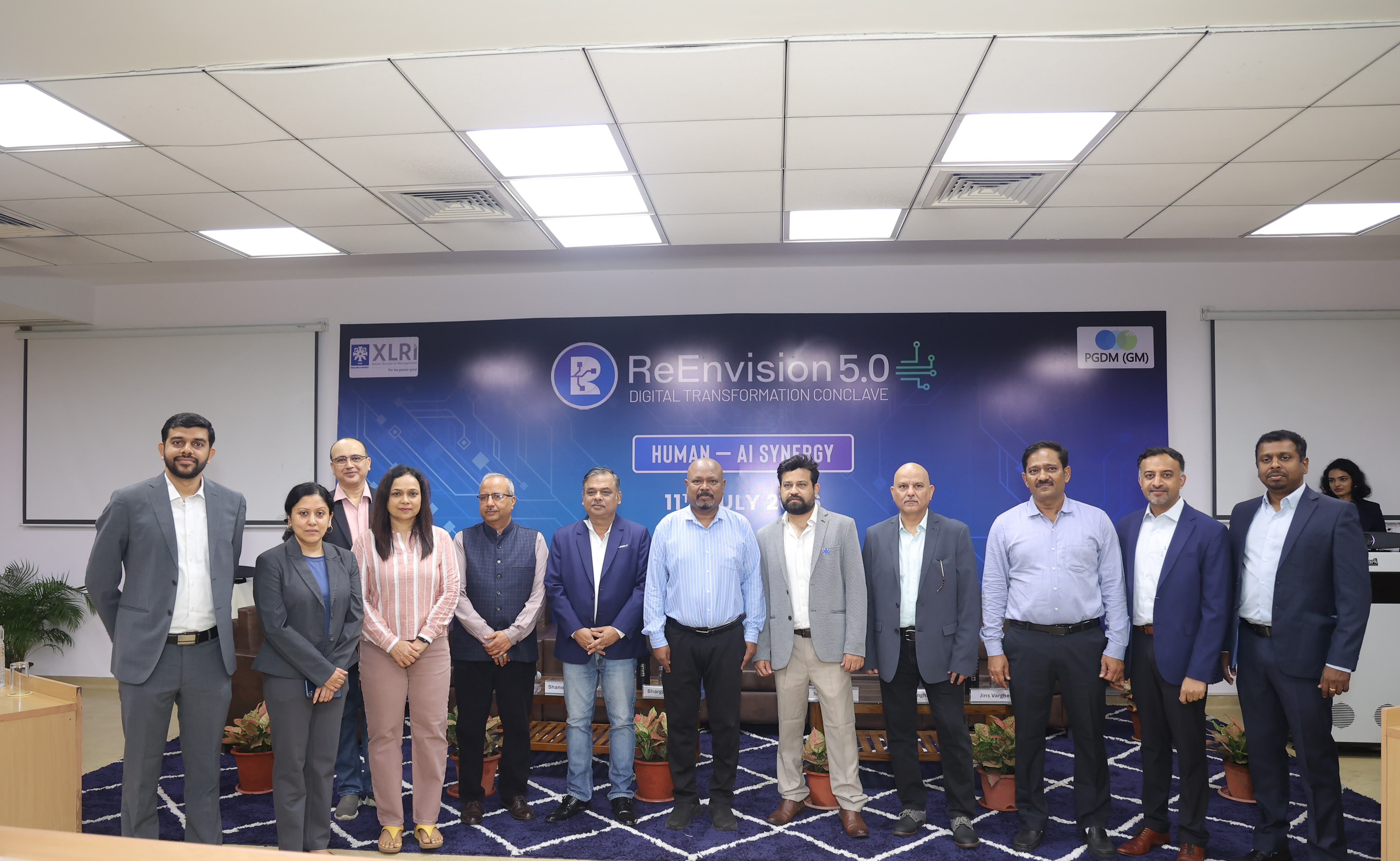
XLRI’s ReEnvision 5.0 Explores the Future of Human-AI Synergy
Jamshedpur, July 18, 2026: XLRI – Xavier School of Management, Jamshedpur, successfully hosted the fifth edition of its flagship digital transformation conclave, ReEnvision 5.0, under the theme “Human-AI Synergy.” The conclave brought together over 150 participants, including more than 12 industry leaders from leading organisations such as Google, Kimberly-Clark, Barclays India Pvt. Ltd., IIFL Capital Services, Blackboard, and Safexpress, among others, to deliberate on the evolving relationship between humans and artificial intelligence and its implications for the future of business and leadership.
The conclave was inaugurated by Dr. (Fr.) George Sebastian, SJ, alongside Prof. A. Kanagaraj and other distinguished guests, who underscored the importance of responsible innovation, ethical AI adoption and stronger collaboration between academia and industry. The inaugural address highlighted that while AI is rapidly transforming organisations, sustainable success will depend on creating a future where technology amplifies human capabilities rather than replacing them.
The first panel discussion, “Co-pilot to Autopilot – The Rise of Agentic AI,” was moderated by Hardik Dhawan and featured Bhargavi Sunkara (Chief Information Officer, Barclays India Private Limited), Hardik Sanghavi (CTO – Institutional Banking, IIFL Capital Services Limited), Jins Varghese (Global Chief Information Officer, Blackboard), Sandeep Dewangan (President and Group CIO, Safexpress Private Limited), and Shanoj Chandroth (Group Chief Digital and Information Officer, Jubilant Bhartia Group). The discussion explored how enterprises are transitioning from AI as a productivity assistant to autonomous, agentic systems, while emphasising that human judgment, continuous learning, and workflow redesign remain critical to unlocking business value.
The second panel discussion, “Leadership in the Age of AI Disruption,” moderated by Nimish Batra, featured Anil Nama (Chief Information Officer, CtrlS Datacenters Ltd.), Ishita De (General Manager and Chief Information Security Officer, Diageo India Private Limited), Nisarg Jha (Leader for Innovation and GenAI, Kimberly-Clark), and Vipin Chawla (Director of Technology & CTO, Antara Senior Care). The discussion examined how leaders must balance technological innovation with governance, cybersecurity, organisational resilience, and a people-first approach while fostering cultures of continuous learning and responsible AI adoption.
The final panel discussion, “Are We Putting Too Much Trust in AI?”, moderated by Harishwar S, brought together Amol Deshpande (Group Chief Digital Officer and Head of Innovation, RPG Group), Dhandapani Shanmugam (Principal Engineer – GCP AI, Google Cloud), and Shree Parthasarathy (Founder and Chief Revenue Officer, Metavarsh). The panel explored trust, accountability, algorithmic bias, transparency, and governance, reinforcing that confidence in AI is built through responsible leadership and robust safeguards rather than technology alone.
A key highlight of ReEnvision 5.0 was the AI Case Challenge, where three student teams presented innovative solutions to real-world business problems before an esteemed panel of industry leaders. The challenge showcased participants’ strategic thinking, analytical capabilities, and practical problem-solving skills while offering valuable industry perspectives through interactive discussions and feedback.
The conclave was coordinated by the student organising committee comprising Abirami S, Utkrisht Suri, Stuti Patwardhan, Morris S, and Muskan Gupta. The three panel discussions were seamlessly moderated by Hardik Dhawan, Nimish Batra, and Harishwar S, while Devika and Shaima served as hosts.
ReEnvision 5.0 reaffirmed XLRI’s commitment to fostering meaningful dialogue at the intersection of business, technology, and leadership. By bringing together industry practitioners, academic leaders, and future managers, the conclave reinforced the importance of responsible innovation and human-centred digital transformation in shaping the AI-driven future.